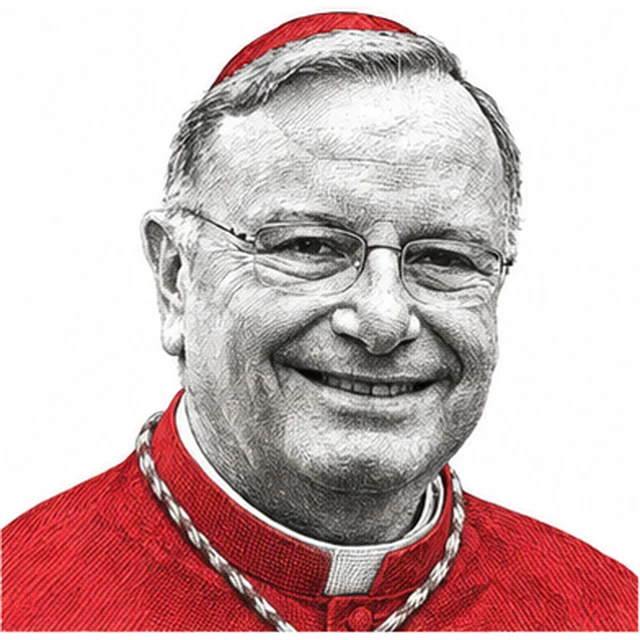
Non-elector
Francesco Montenegro
Italian cardinal, Archbishop Emeritus of Agrigento, known for his commitment to migrants and his open pastoral approach while remaining faithful to tradition.
- Country
- Italy
- Born
- 22 May 1946 (80 years)
- Created cardinal
- by Francis, on 14 February 2015
- Status
- Non-elector: aged 80 or over, he no longer votes in a conclave but takes part in the general congregations
Overall position 30/100 · Progressive
Positions on six themes
How are these scores established?Each theme is scored from 0 (very progressive) to 10 (very conservative). The overall score, out of 100, weights the six themes.
-
Moral doctrine · 25 %
4/10Ahead of the 2015 Synod on the Family, in which he took part, Cardinal Montenegro said he hoped the Church would recognize the family as the central pillar of society while also becoming more open to people of different cultures and sexual orientations, quoting Pope Francis' 'Who am I to judge?'. He has urged the Church to listen and understand rather than condemn. He has not publicly opposed Amoris laetitia or Fiducia supplicans.
-
Liturgy and tradition · 20 %
5/10Cardinal Montenegro is not known to have commented on the traditional Latin Mass or Traditionis custodes. He presents the Eucharist and the liturgy above all as a source of charity and concrete service to the poor, in line with his long work at Caritas.
-
Socio-political engagement · 15 %
1/10As Archbishop of Agrigento, whose territory includes Lampedusa, Cardinal Montenegro became a leading voice for migrants, calling them 'our brothers' and victims rather than threats, and arguing that migration cannot be managed by police measures alone. He led Caritas Italiana and the Italian bishops' Migrantes foundation. He has also denounced the Mafia, refusing a Church funeral to a known Mafia boss in 2012.
-
Stance on Francis's reforms · 20 %
2/10Cardinal Montenegro welcomed Pope Francis to Lampedusa in July 2013, the first journey of the pontificate, and the pope publicly thanked him for his closeness to migrants. Francis created him a cardinal in 2015, a choice he read as a gesture toward the 'last in line' of Europe. As a member of the Dicastery for Promoting Integral Human Development, he presented the pope's Lenten message in 2022.
-
Interreligious dialogue · 10 %
2/10Cardinal Montenegro presents Sicily as an example of welcome and dialogue, recalling a shrine on Lampedusa where Christians and Muslims once prayed side by side. He has said that believers and non-believers must work together for a new order of solidarity and that difference is a richness rather than a problem.
-
Communication and pastoral style · 10 %
2/10Known as 'Don Franco', Cardinal Montenegro prefers that title to 'Eminence' and speaks in plain, direct and image-rich language, describing migrants as a 'sacrament of God's presence' and Lent as a 'gym' for the Christian life. He often draws on personal anecdotes and on the example of Mother Teresa.
Career
- 2000 – 2008Auxiliary bishop
- 2000 – 2008Titular bishop
- 2008 – 2021Roman Catholic Archbishop of Agrigento
- since 2015Cardinal priest
- 2023 – 2025Apostolic administrator
- Episcopal consecration
- 18 March 2000
- Consecrators
- Francesco Sgalambro, Giovanni Marra, Ignazio Cannavò
- Languages spoken
- Italian