Pope Francis's personal diary published, edited by Cardinal Fernández
Edited and annotated by Cardinal Víctor Manuel Fernández, a book gathers the notes Jorge Mario Bergoglio wrote in a personal agenda between 1992 and 2024. It is published on 24 November 2026 in five languages.
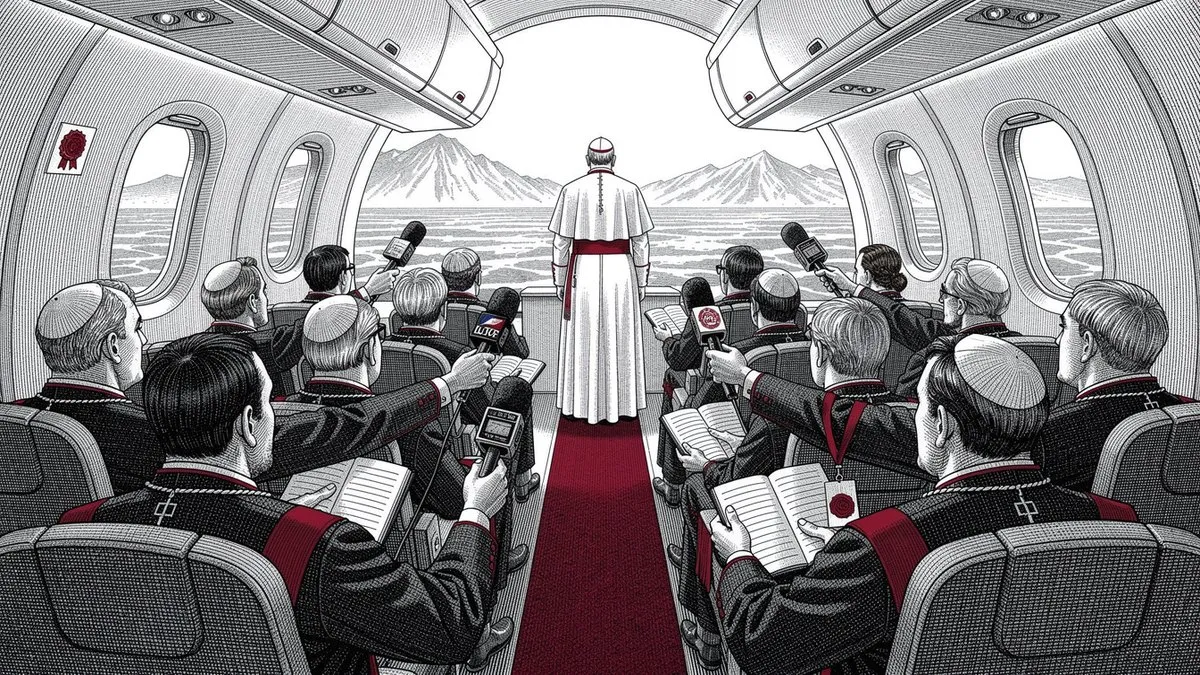
On 24 November 2026, a year and a half after the death of Pope Francis on 21 April 2025, a book drawn from his private notes is published. In Italian, it is titled Il Diario personale di Papa Francesco and is published by the Libreria Editrice Vaticana (LEV). Cardinal Víctor Manuel Fernández, Prefect of the Dicastery for the Doctrine of the Faith, selected the texts, introduced them and provided commentary. The book runs to about 160 pages. It brings together notes written by Jorge Mario Bergoglio between 20 December 1992 and 18 August 2024. According to Vatican News, it is being released simultaneously in five languages and will be distributed in 94 countries.
A black-covered agenda
Bergoglio wrote these brief notes in a small, slanted hand in an agenda with a black plastic cover. The agenda dated from his years in Buenos Aires, and he later kept it at the Casa Santa Marta. Cardinal Fernández recounts how he learned of it in an interview given to Andrea Tornielli, Editorial Director of the Dicastery for Communication. One afternoon, at Santa Marta, the pope showed him a place where three documents and an agenda that served as a diary were kept. He told him, according to the Italian version of the interview: "Di questo vedrete voi" ("You will take care of this"). The cardinal says he remembers precisely only one other phrase: to publish "what is for edification."
After the election of Leo XIV, Cardinal Fernández spoke of this request to the new pope. The latter found the box that contained the texts and sent it to him. According to the prefect, Leo XIV approved his undertaking. He also considered the commentaries that provide context to be important, because the texts alone might disturb readers who did not know Francis well.
The cardinal removed practical details of no interest, repeated sentences and passages about living persons. He also set aside pages written in signs that he likens to "hieroglyphs", out of respect for the pope's wish that they not be read.
Fears, spiritual combat and devotions
According to Vatican News, the author admits his fears several times in these notes. "I am afraid," he writes, of not being equal to his office or of harming others. He entrusts himself to Saint Thérèse of Lisieux, Saint Joseph and the Virgin. He also mentions his fatigue and his health problems, as early as the 1990s.
The book contains several passages on the struggle against evil. "I saw the devil," Bergoglio writes of scenes set during a car journey and during a Mass. In 2016, he notes: "If the devil attacks so brazenly, it is because I do not have much time left and he wants his prey." On another date, he writes that he resisted a "pagan seduction" by praying the rosary: "The Virgin saved me." Cardinal Fernández cites among the passages that struck him most the one dated 7 June 2018: "Last night, I saw the entrance to hell. Pagan seduction in all its force." He also cites the one dated 1 May 2019: "I had the certainty that the Lord loved me with a special love."
The prefect says he was surprised, even shocked, by contents he had never heard of. He first hesitated to publish the most intimate passages, then chose to keep as many as possible. According to him, Francis described his spiritual contact with Jesus and Mary in simple terms. He had never spoken of it with the cardinal.
The 2021–2022 crisis
Cardinal Fernández states that Francis went through "a serious spiritual crisis in 2021 and 2022." According to Vatican News, the crisis lasted about two years and coincided with the worsening of his illness; the book's introduction compares it to the "dark night" described by Saint John of the Cross. During this crisis, the pope says he felt "decisive assaults of the forces of evil." He also recounts a moment of prayer in the chapel: "He smiled… I felt the merciful gaze of Jesus."
For the prefect, this trial led to the most mature synthesis of Francis's spirituality: total abandonment to the Lord, which leads to respect for the dignity of others. He links it to the last two major texts of the pontificate, the apostolic exhortation C'est la confiance (2023), devoted to Saint Thérèse of Lisieux, and the encyclical Dilexit nos (2024). In his view, the earlier documents of the pontificate should be read in the light of these two texts.
The cardinal also presents the book as a way of letting Francis speak and of defending him against criticism he considers unjust. He acknowledges that his own silence about the late pope was partly due to cowardice.
The Italian edition is published by the LEV. The Spanish, English and Portuguese editions are entrusted to subsidiaries of Penguin Random House, and the French edition to Albin Michel. The LEV had presented the work to international publishers at the Frankfurt Book Fair, from 7 to 11 October 2026.
Sources
- Fernández: “Il Diario rivela il cuore di Francesco e la sua spiritualità” · Vatican News
- Cardinal Fernández: 'The Diary reveals Francis' heart and his spirituality' · Vatican News
- Il Diario personale di Papa Francesco · Vatican News
- The Personal Diary of Pope Francis · Vatican News
- Pope Francis' personal diary, a book by Cardinal Fernández · Vatican News
- A un anno e mezzo dalla morte di Francesco esce il suo diario personale: un libro per scoprire l’uomo dietro il Papa · Avvenire