Lethal autonomous weapons: in Geneva, the Holy See calls for a moratorium and a binding legal framework
In a working paper submitted to the 7th Review Conference of the Convention on Certain Conventional Weapons, the Holy See asks that life-and-death decisions remain in human hands. It echoes the language of the encyclical Magnifica humanitas.
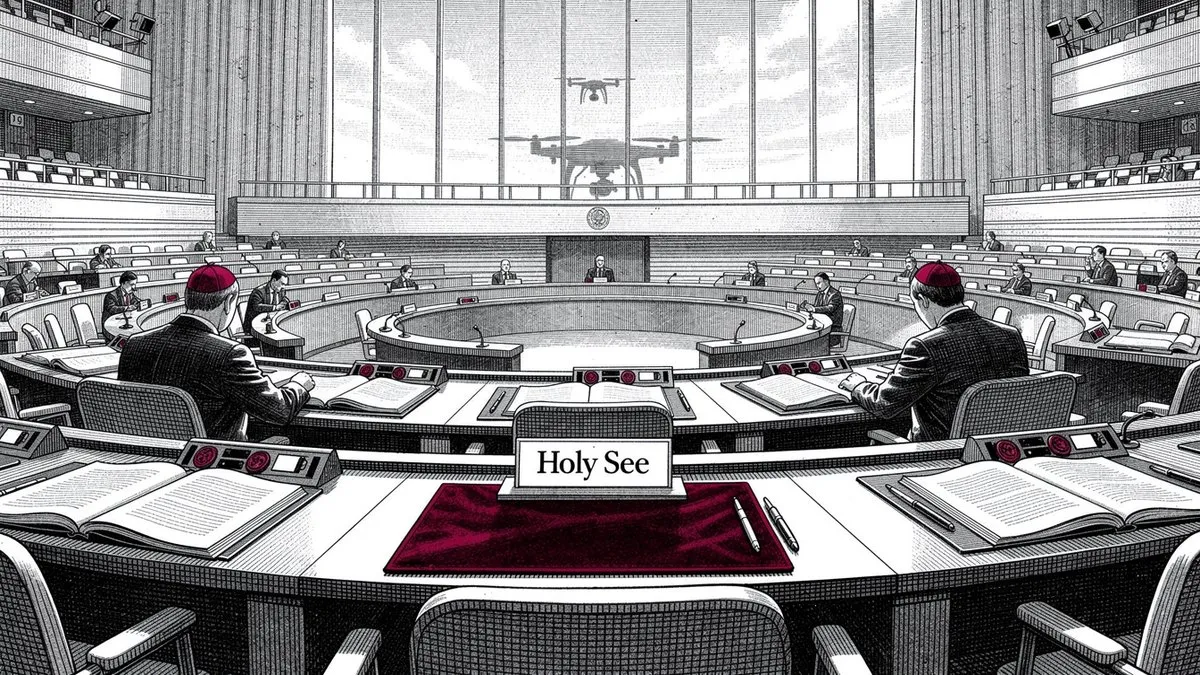
The Holy See has submitted a working paper on lethal autonomous weapons systems (LAWS) to the Seventh Review Conference of the Convention on Certain Conventional Weapons (CCW), held in Geneva from 16 to 20 November 2026. In it, it calls for a moratorium on the development and use of these weapons, a binding international legal framework and an explicit ban on systems that target human beings. Vatican News, which presented the document on 20 November, summarized it with a phrase inspired by the first encyclical of Leo XIV: "No algorithm can make war morally acceptable."
A machine calculates, it does not judge
The text recalls that LAWS have been studied within the framework of the CCW for more than ten years. It draws on the final report of the Group of Governmental Experts, adopted on 4 September, as evidence of a broad convergence of views. According to the Holy See, the time has come to translate this consensus into a concrete framework.
The central argument is a moral one. A machine can only calculate, whereas moral judgment presupposes a conscience and the recognition of the other as a person. Lethal or irreversible decisions must therefore not be entrusted to artificial systems. For the Holy See, compliance with international humanitarian law is necessary but not sufficient. The document invokes the Martens Clause and stresses that notions such as proportionality require human judgment.
The text also lists risks of unpredictability: self-learning systems, programming errors, biased data, cyberattacks, unforeseen interactions between opposing algorithms, which may lead to rapid and uncontrollable escalation. It calls for effective human control, one that can be held to account and that speed must not short-circuit. Responsibility must remain with the persons who design, authorize and use these systems, and not with the machine.
Finally, the Holy See takes up a proposal made in 2021 at the Sixth Review Conference: the creation of an International Organization for Artificial Intelligence. At that time, its delegation was already calling for a moratorium on the development and use of LAWS while negotiations were under way. The document also acknowledges that AI can serve to protect civilians, to provide early warning and to verify compliance with arms control agreements.
A diplomacy of a State party
At the United Nations, the Holy See has the status of a permanent non-member observer State. It does not vote in the General Assembly but takes part in its work and in that of its agencies. In the case of the CCW, its position is different: it acceded in 1997 to the Convention and to its first four protocols, then to Protocol V on explosive remnants of war in 2005. It therefore sits in Geneva as one of the High Contracting Parties, numbering 128 according to UN News.
The Holy See's text arrives in a context of multilateral pressure. At the opening of the conference on 16 November, UN Secretary-General António Guterres called on delegates to move toward a legally binding instrument containing "clear prohibitions and restrictions." UN News noted, however, that there was still no agreement on the nature of any new instrument or on its timetable.
In line with Magnifica humanitas
The document follows in the line of Magnifica humanitas, the encyclical "on the protection of the human person in the age of artificial intelligence," dated 15 May 2026. Paragraph 197 observes that the autonomy of weapons makes war "more 'accessible' and less subject to human control." Paragraph 198 states: "There is no algorithm capable of making war morally acceptable." Paragraph 199 adds that "irreversible decisions cannot have speed and efficiency as their supreme criteria," and proposes three criteria for discernment: responsibility, the time left for human judgment, and the protection of civilians. Paragraph 200 draws the conclusion: "the decision to resort to lethal force cannot be delegated to opaque or automated processes."
On 17 November in Sofia, the day after the opening of the conference, Cardinal Michael Czerny, Prefect Emeritus of the Dicastery for Promoting Integral Human Development, presented the encyclical from the perspective of war and peace, at a meeting organized by the Bulgarian Academy of Sciences and the Apostolic Nunciature. He stressed a chain of responsibility that is "identifiable and verifiable," and the fact that decisions to resort to lethal force must remain in human hands, with identifiable decision-makers.
Sources
- Saint-Siège: «Aucun algorithme ne peut rendre la guerre moralement acceptable» · Vatican News
- Holy See: 'No algorithm can make war morally acceptable' · Vatican News
- Lettre encyclique Magnifica Humanitas du Saint-Père Léon XIV sur la protection de la personne humaine à l'ère de l'intelligence artificielle · Saint-Siège (vatican.va)
- Cardinal Czerny urges human accountability for AI in warfare · Vatican News
- Guterres calls for a legally binding instrument for 'killer robots' · ONU Info (UN News)
- Adhesion of the Holy See to the Protocol on Explosive Remnants of War (ERW) · Saint-Siège (vatican.va)