† Deceased
John Paul II
Karol Wojtyła
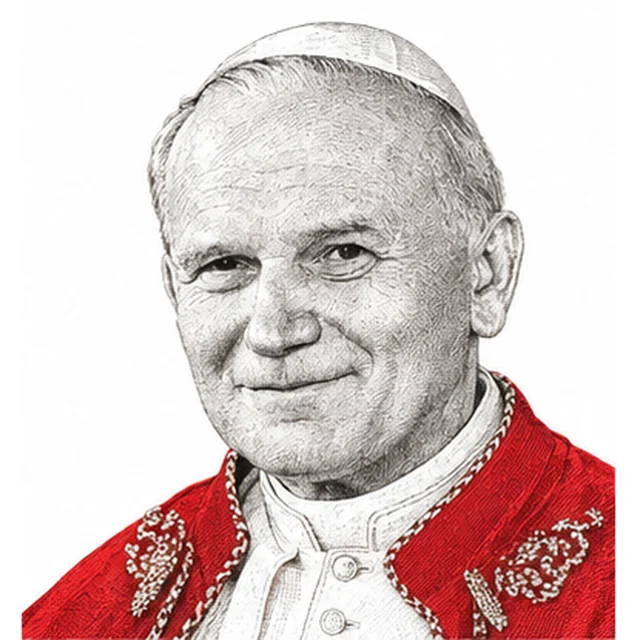
Karol Wojtyła, elected as John Paul II, was pope from 1978 to 2005, becoming the first Polish pontiff and first non-Italian since 455 years. John Paul II's pontificate, one of the longest in history, was marked by his role in the fall of communism, his numerous travels (129 countries visited), his commitment to interreligious dialogue and a firm defense of traditional moral doctrine. His charismatic personality and ability to communicate with crowds redefined the modern papacy.
- Country
- Poland
- Born
- 18 May 1920
- Created cardinal
- by Paul VI, on 26 June 1967
- Pope
- 16 October 1978 – 2 April 2005
- Status
- Died on 2 April 2005
Overall position 63/100 · Moderately conservative
Positions on six themes
How are these scores established?Each theme is scored from 0 (very progressive) to 10 (very conservative). The overall score, out of 100, weights the six themes.
-
Moral doctrine · 25 %
10/10Pope John Paul II maintained a staunchly conservative stance on moral issues. He firmly opposed abortion, euthanasia, contraception, and same-sex unions, emphasizing the sanctity of life and traditional family structures. His teachings, particularly in 'Evangelium Vitae' and 'Theology of the Body,' reinforced the Church's long-standing doctrines on these matters.
-
Liturgy and tradition · 20 %
8/10John Paul II exhibited a deep reverence for liturgical tradition. He authorized the 1984 indult permitting the Traditional Latin Mass under certain conditions, aiming to reconcile with traditionalist groups. While he supported the post-Vatican II liturgical reforms, he also emphasized the importance of preserving the Church's liturgical heritage.
-
Socio-political engagement · 15 %
3/10John Paul II was a vocal advocate for social justice, emphasizing the rights of workers, the poor, and migrants. He addressed issues like economic inequality, human rights, and the moral responsibilities of nations, urging the Church to be a beacon for the marginalized.
-
Stance on Francis's reforms · 20 %
8/10While John Paul II and Pope Francis share a commitment to social justice and outreach to the marginalized, their approaches diverge on certain doctrinal and liturgical matters. John Paul II upheld strict doctrinal positions and traditional liturgical practices, whereas Pope Francis has adopted a more pastoral and inclusive approach. It's plausible that John Paul II would have supported Francis's emphasis on mercy but might have expressed reservations about certain reforms, especially those related to liturgy and moral teachings.
-
Interreligious dialogue · 10 %
2/10John Paul II was a pioneer in interreligious dialogue, fostering relationships with leaders of various faiths. He organized the historic 1986 Assisi interfaith prayer meeting and made significant efforts to improve Catholic-Jewish and Catholic-Muslim relations, emphasizing mutual respect and understanding.
-
Communication and pastoral style · 10 %
3/10John Paul II was renowned for his charismatic communication style, effectively utilizing media to convey the Church's message. He embraced modern communication tools, delivering impactful speeches and writings that resonated with both Catholics and the broader global audience.