† Deceased
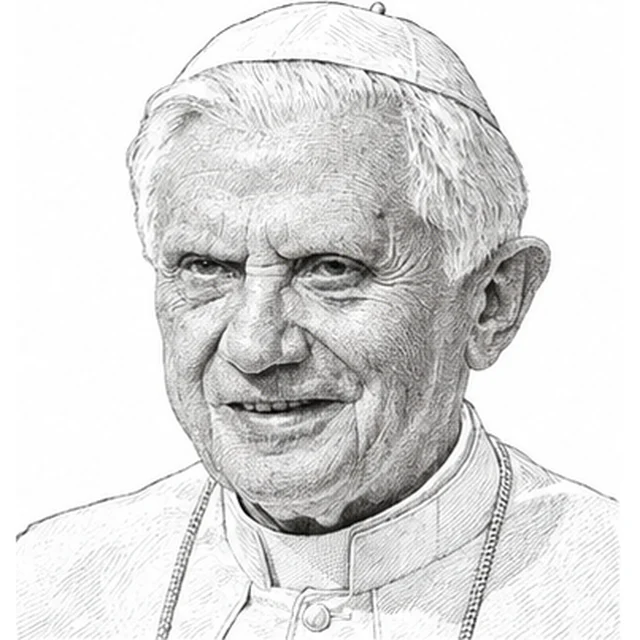
Benedict XVI
Joseph Ratzinger
Joseph Ratzinger, who took the name Benedict XVI, was pope from 2005 to 2013 and is the first pontiff to renounce his office in almost 600 years. Pope Benedict XVI, an eminent theologian, is known for his intellectual depth, defense of Catholic doctrine and attachment to traditional liturgy. His pontificate was marked by a dialogue between faith and reason, continuity with John Paul II and a response to the challenges of secularization and relativism.
- Country
- Germany
- Born
- 16 April 1927
- Created cardinal
- by Paul VI, on 27 June 1977
- Pope
- 19 April 2005 – 28 February 2013
- Status
- Died on 31 December 2022
Overall position 71/100 · Conservative
Positions on six themes
How are these scores established?Each theme is scored from 0 (very progressive) to 10 (very conservative). The overall score, out of 100, weights the six themes.
-
Moral doctrine · 25 %
9/10Pope Benedict XVI upheld traditional Catholic moral teachings with unwavering clarity. He strongly opposed abortion, same-sex marriage, and assisted reproduction, emphasizing that such practices are contrary to natural and divine law. His writings consistently affirmed the sanctity of life from conception to natural death and the traditional understanding of marriage as a union between a man and a woman.
-
Liturgy and tradition · 20 %
9/10Benedict XVI had a profound appreciation for the Church's liturgical heritage. Through the 2007 motu proprio 'Summorum Pontificum,' he expanded access to the Traditional Latin Mass, aiming to reconcile divisions and enrich the Church's liturgical life. Although he personally did not publicly celebrate the Tridentine Mass as pope, his theological vision emphasized continuity with liturgical tradition.
-
Socio-political engagement · 15 %
4/10While not as prominently engaged in sociopolitical activism as some successors, Benedict XVI addressed social issues through his writings, notably the encyclical 'Caritas in Veritate.' He advocated for a global economic order centered on human dignity and the common good, emphasizing love as a force for justice and peace. His messages on migration highlighted the right to remain in one's homeland and the need for collaborative policies respecting migrants' rights.
-
Stance on Francis's reforms · 20 %
8/10Although Benedict XVI showed personal loyalty and public support for Pope Francis, there were significant differences in theological emphasis and ecclesial governance. Benedict’s positions on liturgy, moral theology, and Church identity contrast with Francis’s more pastoral, inclusive tone. Some of his close collaborators have been among the most vocal critics of Francis’s reforms, and Benedict’s silence on certain issues was often interpreted as tacit reservation.
-
Interreligious dialogue · 10 %
5/10Benedict XVI engaged in interreligious dialogue, emphasizing mutual respect and the pursuit of truth. He maintained that dialogue should not compromise doctrinal integrity and cautioned against relativism. His approach was marked by a balance between openness to dialogue and fidelity to Catholic doctrine.
-
Communication and pastoral style · 10 %
6/10Benedict XVI's communication style was scholarly and theologically rich, reflecting his background as a theologian. While not as media-savvy as some contemporaries, he recognized the importance of digital media, encouraging its use for evangelization while advocating for thoughtful and respectful discourse.